

SCIENCE
Science Intent at St Paul’s Primary School
At St Paul’s Primary School, we follow the National Statutory Framework for EYFS and the National Curriculum for Key Stage 1 and 2. We teach the knowledge, skills and understanding through Biology, Chemistry and Physics. As children progress through the school so does their confidence and knowledge of how to work scientifically and how to investigate. The main focus is that of developing scientific enquiry skills which are taught throughout. This enables the children to develop their investigative skills; observing, questioning, fair testing, predicting, measuring, recording, evaluating and concluding in a variety of lessons.
Alongside this, through building up key foundational knowledge and concepts, pupils are encouraged to recognise the power of rational explanation and develop a sense of excitement and curiosity about natural phenomena. They are encouraged to understand how science can be used to explain what is happening, predict how things will behave, and analyse causes with an emphasis on evidence. Emphasis is also placed on practical science investigations to facilitate each child’s learning as this creates excitement and encourages first-hand experience, safe use of equipment, co-operation, enquiring minds, the enjoyment of discovering surprising results and the development of investigative skills.
Through our continuing emphasis on the importance of Science, both in school and around the world, our children develop a clearer understanding of how science influences and changes their lives and how it is vital to the world’s future prosperity. By the time our children leave St Paul’s they will have an understanding of; animals, plants and humans, Light, sound, electricity, forces (push, pull and magnetic) and materials. Similarly, they will have a growing knowledge of our earth; how seasons are created, how gravity works and the phases of the moon.
Why Science is important
- We believe that science stimulates and excites children’s curiosity about phenomena and events in the world around them. It also satisfies their curiosity with knowledge. Because science links direct practical experience with ideas, it can engage learners at many levels.
- We believe science will lead to a better understanding of ourselves and the world. It provides opportunities to appreciate scientific facts and to experience scientific discovery.
- It is about developing children’s ideas and ways of working that enable us to make sense in the world in which they live through investigation, as well as using and applying process skills.
Aims of our Science curriculum
- Engage children as learners at many levels through linking ideas with practical experience
- Help children to learn to question and discuss scientific issues that may affect their own lives
- To increase the child’s knowledge and understanding of the world
- To develop attitudes of curiosity, co-operation, perseverance, open-mindedness, responsibility and independence in thinking
Implementation
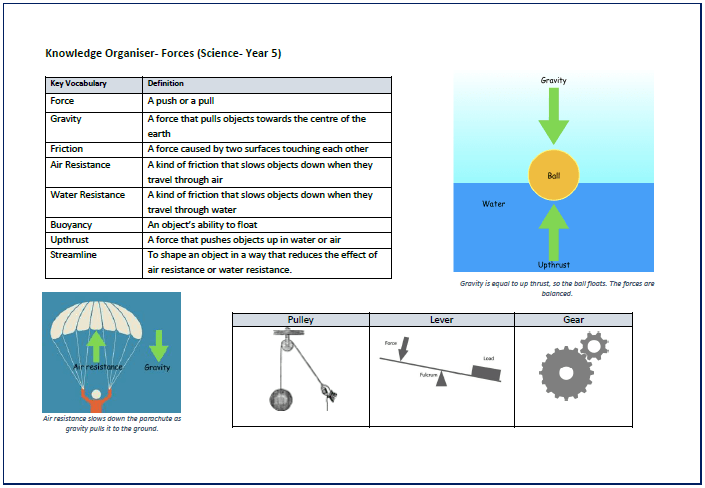
Children are given a knowledge organiser at the beginning of each unit which outlines the main topics and introduces the children to key vocabulary they will be using. These are referred to throughout the science lesson and are displayed on classroom working walls.
All lesson powerpoints contain the following slides:
. Prior learning
. Key vocabulary
. New content
Working Scientifically
To ensure we are working scientifically and completing an investigation, we have to follow the Scientific Method.
- Ask a question
- Form a hypothesis
- Perform an experiment
- Observe and record
- Analyse and conclude
- Communicate the results
Assessment
Assessment takes place at three connected levels: short-term, medium-term and long-term. These assessments are used to inform teaching in a continuous cycle of planning, teaching and assessment.
Knowledge Organiser Sample - SCIENCE
What our pupils think about Science at St Paul's school
We love Science because:
'...it teaches us different things about the world.' - Y2
'We get to do investigations where you find things out.' - Y5
'We can make things and test them.' - Y4
'You can learn lots!' - Y1
''You can learn about Biology.' - Y6
'You can investigate to prove something.' - Y3
'It makes you smarter!' - Y1
My favourite lesson has been:
‘Learning about the particles. Even we are particles because everything is. It’s amazing really.’ - Y4
‘Seasons because we can see them changing outside.’ - Y1
'Shining the torches into the box to see what is in there.' - Y3
‘Textures (materials) for the different habitats that the animals live in.’ - Y2
‘Making a burglar alarm in electricity. You had to make it really loud so it scares them away.’ - Y4
‘Floating and sinking with the clay. We had to make it different shapes and test them. We timed how long it took them to sink.’ - Y6
'Testing our parachutes for air resistance.' - Y5


